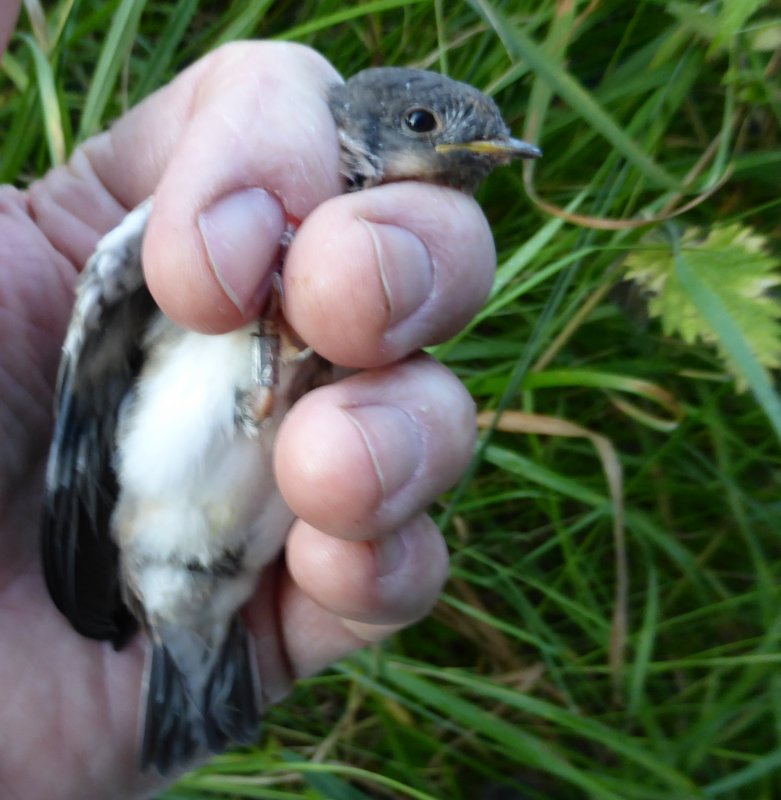
From time to time we catch birds with, well how else can I put it, deformities! Today amongst the numerous Coal Tits ringed at the Lodge was this bird.
At first it looked like the whole bill was crossed but on closer examination it became apparent that the offending article was actually the lower mandible skewing to the left. We debated whether in the interests of the bird's welfare we should try and 'trim' the end to hopefully encourage even wear, but it seems the acquired wisdom is to leave well alone, which we did. The bird had a healthy weight and looked in good shape, so I'm sure it will be OK.
Sunday, 27 September 2015
Thursday, 20 August 2015
Sexing juvenile Siskins.
Today there has been a flock of about 60 Siskins at my ringing site. I have not had much luck tape luring and the call did not seem to work. I decided to try the song. It was a little more effective and I caught seven birds.
In the recent Ringing and Migration I had read an article on sexing using the amount of black on the second outer-most tail feather. I decided to give it a go.
On some birds the blotch went almost to the base of the tail. It was difficult to measure, but the longest I recorded was 29.9. I presume a female, but it needs to be above 30 to be certain according to the paper.
An adult male was 25.2 and a 3j had a measure of 24.5. The shortest I recorded was 17.8 on a 3. See below. Both these juveniles had some black feathers coming on the crown so I was able to sex them without the tail criteria.
It was good to see so many Siskins and I am sure some have bred locally.
Tuesday, 11 August 2015
Nervous nineties
The team assembled at the treatment works 'scrub' this morning based on my optimistic but hopeful promise of a 100 bird session.
Just like a batsman entering the nervous nineties we got to the final net round about 11:30. One had about 10 birds but the others had precisely .... none. The umpires decision? 'out' LBW (Little Brown Warbler) but we made 92.
The remarkable thing about this site in July and August is that the vast majority of birds are post breeding migrants, It's hard to know quite where they all come from as a number of species ringed in the last 3 weeks certainly do not breed on site and today's total included a number of cases in point. This juv Yellowhammer was actually a site tick.
Other non residents included Garden Warbler and Lesser Whitethroat. The 'scrub' is however Whitethroat central and we have ringed large numbers of this years birds including a very creditable 25 today.
Friday, 7 August 2015
Juvenile Siskins at Hicks Lodge.
Ringing at Hicks Lodge this am resulted in a new site ringing tick. Three juvenile Siskins were caught.
Siskin is classified as a very rare breeder in the county, but these two look like they have not travelled far. A probable breeding record.
A total of 20 birds were caught including Whitethroat, Garden Warbler, Blackcap and Willow Warbler.
Siskin is classified as a very rare breeder in the county, but these two look like they have not travelled far. A probable breeding record.
A total of 20 birds were caught including Whitethroat, Garden Warbler, Blackcap and Willow Warbler.
Sunday, 2 August 2015
Juv Goldcrest gets its 'crest'
Two of the first three birds caught and ringed at the sewerage treatment works yesterday were juv Goldcrests. The first was in completely juvenile plumage - no crest, but the second was undergoing its post-juvenile moult, replacing fluffy olive green crown feathers with the characteristic 'gold' feathers that give the species its name. Interestingly not only is this individual growing yellow 'gold' but orange 'gold', so it can confidently be identified as a male, even at this early stage.
Friday, 3 July 2015
First Ringing at Desford Sand Martin Wall.
We managed to ring our first young Sand Martins from the artificial wall located at Desford Lakes.
Chris checking the nests.
Each hole was numbered so we can record how successful the wall is over the coming years. Of the 80 holes 31 were or had been used this year.
Some nests had eggs, but in this case chicks were just in the process of hatching. We will return to ring these birds when they are bigger.
Tuesday, 30 June 2015
Juvenile Kingfisher at WCP.
A juvenile Kingfisher was a nice catch at Watermead CP this morning.
Possibly a male as the crown, lower back and rump are predominantly blue or blue-green.
However, some of the lower mandible is pale orange, although males can also have some pale orange at the base.
Brown smudges on the breast feathers, another juvenile feature.
Without these subtle features, viewed at distance, this bird would possibly pass as an adult male.
Brown on the front of the tarsus and upper foot aged this as a 3. Just visible in this image.
I love the white throat patch. The dark breast band shows up well in this image.
As always with Kingfishers, prior to release they are very happy to pose for the camera!
The crown appears more green or green-blue in this photo, hence our caution with sexing.
Subscribe to:
Posts (Atom)